Showing posts with label music. Show all posts

Friday, July 4, 2025

Star Show

Last Thursday we followed our granddaughter's suggestion and visited a nearby theatre to watch The Guardian of the Star - a production of The Melbourne GangShow - CLICK.

The theatre - The Besen Centre - CLICK - promised the best quality, artists delivered :)

Artists...
After entering the theatre foyer we realised that we are in the midst of Australian Scouts. Most of people around, young and old, were wearing either a scout scarf or some other scout insignia.

Before the show... I had to admit that I was bit worried... Melbourne Gang - I felt a promise of a very loud, aggressive music, sloppy behaviour, maybe some vulgarity, although presence of Scouts neutralised the last objection.

Title - The Guardian of the Star - promised some obscure legend.

The show started and our hearts and objections melted.
Pleasant music, great singing - both - choral and solo and wonderful choreography. Quite frequently we watch ballet performances and here, there was no dance but perfect coordination of many people on the stage.
In the background - impressive decorations.

Our rating 10 out of 10!

We just wondered that this performance was not advertised outside the close knit Scouts Community - great loss for many Melbournians.

Now we will keep our eyes and ears wide open.

The final scene of the performance - HERE - warning - sometimes preceded by a short ad.

Wednesday, February 19, 2025

Be Be

 My first words this (and previous) morning were - brrrr, brrrr - so cold.
In our 42 years of life in Australia we never before switched on heating in February.

Why Be Be or double B?
Memory from 70 years ago - BB = Brigitte Bardot - CLICK.
I lived in a communist Poland and I am not sure when I saw BB in a movie but she was present in the papers and movie newsreels.
I was also aware of two other BBs - very popular German writer Bertold Brecht and not so popular Hungarian composer Bela Bartok.

Those memories revived at the end of 2023 when I got a message from Melbourne Symphony Orchestra about a concert - pianist Berta Brozgul will perform Bela Bartok's piano concerto No 3.
Unfortunately I could not attend this performance but I remember the name.

And here it came - Brunswick Beethoven Festival - Sofia Kirsanova - violin and Berta Brozgul - piano will play violin sonatas by L. Janacek and L. van Beethoven.

In last 3 months I experienced a serious health deterioration so I could not plan ahead any travel to the city in evening hours. 
On Tuesday (18/2) I had an early dinner and at 6:30 pm decided that I am able to GO!

Concert took place in Brunswick Uniting Church. I arrived over half an hour before the performance, the church was closed, few people sheltered from cold wind in door niches.
- I am from Latvia - one lady introduced herself - because the violinist is Latvian. I introduced myself as Polish and to my surprise I got reinforcement of one lady.
There was one more lady around and she introduced herself as Australian - odd.

Eventually we were allowed to enter the church, there were around 150 people, my guess is there were no more than 5 people under 50 years of age.

The concert began...
I am not qualified to evaluate the performance although I was more moved by L. Janacek Sonata.

As for Kreutzer sonata I have another story...
Famous Russian writer - Leo Tolstoy - wrote a novella - Kreutzer Sonata.
This is a story about a man who killed his wife because he suspected her of marital infidelity with her music teacher and the inspiration to betrayal was - Beethoven's Kreutzer Sonata.
There is L. Tolstoy's opinion:
"They say that music stirs the soul. Stupidity! A lie! It acts, it acts frightfully (I speak for myself), but not in an ennobling way. It acts neither in an ennobling nor a debasing way, but in an irritating way. How shall I say it? Music makes me forget my real situation. It transports me into a state which is not my own. Under the influence of music I really seem to feel what I do not feel, to understand what I do not understand, to have powers which I cannot have. Music seems to me to act like yawning or laughter; I have no desire to sleep, but I yawn when I see others yawn; with no reason to laugh, I laugh when I hear others laugh. And music transports me immediately into the condition of soul in which he who wrote the music found himself at that time. I become confounded with his soul, and with him I pass from one condition to another. But why that? I know nothing about it? But he who wrote Beethoven’s ‘Kreutzer Sonata’ knew well why he found himself in a certain condition. That condition led him to certain actions, and for that reason to him had a meaning, but to me none, none whatever.
And that is why music provokes an excitement which it does not bring to a conclusion.
For instance, a military march is played; the soldier passes to the sound of this march, and the music is finished. A dance is played; I have finished dancing, and the music is finished. A mass is sung; I receive the sacrament, and again the music is finished.
But any other music provokes an excitement, and this excitement is not accompanied by the thing that needs properly to be done, and that is why music is so dangerous, and sometimes acts so frightfully.
"
Copied from Project Guttenberg (guttenberg.com).

I had this words in mind listening to the concert performance probably therefore I found it... short of madness :(
Here is a link to a performance with a bit of madness - CLICK - no wonder - the violinist is Moldavian, the pianist - Turkish. 

One interesting point - here is the text of original dedication: "Sonata mulattica composta per il mulatto Brischdauer [Bridgetower], gran pazzo e compositore mulattico" (Mulatto Sonata composed for the mulatto Brischdauer, great madman mulatto composer).
George Bridgetower - look HERE - musician of Polish descent, born in Biała Podlaska...
Actually Biała means in Polish - White.
Isn't it mad?

 And one more quote from L. Tolstoy novella - something written 135 years ago but still valid: The absence of the rights of woman does not consist in the fact that she has not the right to vote, or the right to sit on the bench, but in the fact that in her affectional relations she is not the equal of man, she has not the right to abstain, to choose instead of being chosen. You say that that would be abnormal. Very well! But then do not let man enjoy these rights, while his companion is deprived of them, and finds herself obliged to make use of the coquetry by which she governs, so that the result is that man chooses ‘formally,’ whereas really it is woman who chooses. As soon as she is in possession of her means, she abuses them, and acquires a terrible supremacy.”
“But where do you see this exceptional power?”

“Where? Why, everywhere, in everything. Go see the stores in the large cities. There are millions there, millions. It is impossible to estimate the enormous quantity of labor that is expended there. In nine-tenths of these stores is there anything whatever for the use of men? All the luxury of life is demanded and sustained by woman. Count the factories; the greater part of them are engaged in making feminine ornaments. Millions of men, generations of slaves, die toiling like convicts simply to satisfy the whims of our companions".

Wednesday, April 17, 2024

Mozart beyond the glass

 We are regular goers to Mostly Mozart series in Melbourne Recital Centre.
As the name indicates there is W.A.Mozart music in the program plus someone else.

This time the title was surprising - Glass Harmonica.
Glass Harmonica?
I do not think I ever heard such an instrument, I dimly recollect that it produces music similar to xylophone, it sounds in some cloudy, watery way - definitely not Mozart style.

Day before the concert I decided to widen my knowledge of the subject and practically it took me the whole day and I am still not satisfied.

Firstly I learned that glass harmonica is a most dangerous musical instrument in history of music - people exposed to it experienced - attacks of panic, epilepsy, women - miscarriages - consequently it was forbidden to play it in public places - more HERE.

Secondly - glass harmonica was invented in 1761 by Benjamin Franklin, I knew this name as an inventor of lightning rod. After reading an entry in Wikipedia I got to conclusion that he was a most capable brain ever - just check -- CLICK.

So what Mozart could get out of glass harmonica?
The answer is HERE.
No surprises - not much Mozart brilliance here.

The important question was - who will support Mozart this time?
It was Hungarian composer Gyorgi Ligeti, I heard before few pieces of his music and thought that it may suit glass harmonica.

The last question was - do we have a glass harmonica in Australia?
If so, where it was hidden? Why it was never publicly played?

The answer was simple - Glass Harmonica will not be there!
It was replaced by various combinations of xylophones, vibraphones, marimbas and...


... yes, glasses and glass bowls half filled with water. All operated by 4 people...

And it produced amazing sound.

And here is a piece by G. Ligeti, here played by a "proper" orchestra, but combination of various percussion instruments and glass gave similar effect - CLICK.

Monday, September 18, 2023

Gold Mountain

On Saturday I went downtown to a concert at the Scots Church. The program - Goldberg Variations by J.S. Bach - performance on harpsichord- CLICK.

Goldberg variations, so many associations, where to start?

Maybe from the beginning...
It started with Augustus III Saxon becoming the king of Poland.
As a Saxon Elector, he was also the king of Johann Sebastian Bach, who lived in Saxony.
J.S. Bach saw already during the times of Augustus II "the Strong" Saxon, what was going on and approached the royal court in Warsaw with an application for the position of court composer.
He wrote a special Catholic mass for this occasion (Mass in B minor).
After a considerable delay, the application was approved and Bach realised what was squeaking at the royal court.

Squealed the Russian ambassador - Herman Klaus von Keyserling, who suffered from insomnia and hired a young, very talented composer and harpsichordist, born in Gdańsk, Johann Gottlieb Goldberg (Gold Mountain) to play for him to help him fall asleep.

During Keyserling's visit to Dresden, J.G. Goldberg met the Bach family, and J.S. Bach commemorated this acquaintance with a composition

I encountered the Goldberg Variations many years ago, thanks to Glenn Gould's famous recording - CLICK.

This recording was so popular that I did not look around for anything else, so something else came to me in the promotion from Australian Chamber Choir.

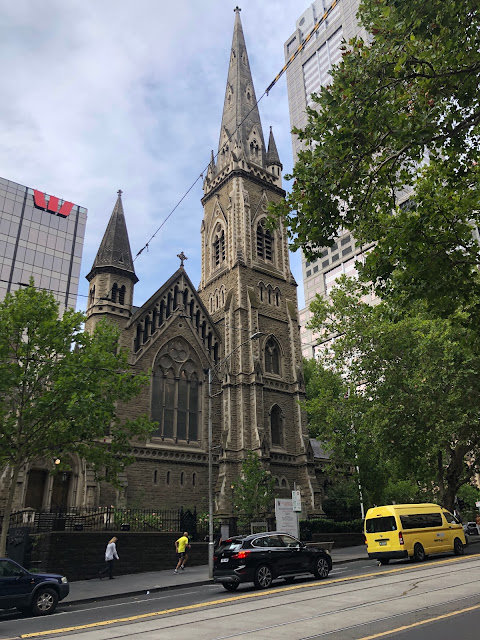
Scots Church, just in the centre of Melbourne...

Nearby there are many churches - Baptists, Methodists, the Catholic Cathedral of St. Peter, the Anglican Cathedral of St. Paul - these were the times of gold rush in nearby Ballarat, and since gold attracts a sin then there was a search for salvation.

There are banks squeezed between the churches - this red sign on the glass skyscraper is the symbol of the Westpac bank.
Complete harmony.

The disadvantage was the location of the church - right in the middle of Melbourne, there is no way to get there by car, for my wife taking a tram, including transfers, was too troublesome, she stayed home.

Inside the church...

This is what I expected - the spring school holidays just starting, the Australian Football and Rugby League finals are next week, and it's a beautiful, sunny day with crowds pouring through the streets of Melbourne.

Mountains of gold are difficult to reach, but at our fingertips we have the sweets of this world available - the Mountain of Sugar (Zuckerberg).

The overall impression of the concert - definitely positive - I am not a fan of the harpsichord, but in many cases the harpsichord provided effects unavailable to the piano.

Time to return, I'm going to the tram stop, on the way I'm stopped by a demonstration commemorating the death of Mahsa Amini in an Iranian prison...

The last look on the city...

Again, a church brings harmony and a peace of spirit.

Sunday, August 20, 2023

Whole Notes

Whole NotesWhole Notes by Eddie Ayres
My rating: 3 of 5 stars

My remote contact with Emma and Ed Ayres started many years ago.
For many years it was listening to smooth voice of Emma presenting classical music on ABC/Classic - Morning.
At that time I had and opportunity to see her in action - ABC/Classic was broadcasted live from Percy Grainger museum.
I saw Emma and I realised that she is not quite comfortable in her role.
Then she disappeared from radio ABC and I met her on a book shelves - Danger Music - a relation from Emma's work in a music school in Afghanistan.
She explained that she could not cope with serene climate of her job and surrounding as she was tormented with a war inside, she needed to be surrounded by danger to keep some balance.
Then came another book - Cadence - relation from a solo bike travel from England to Hong Kong.
It was good to have such an introduction so I could read Whole Notes in relaxed mode.
Basically the book covers whole life of Ed, all experiences intertwined with music.
Experiences are many -daily life issues, experience of a student, performer, teacher, mature age student.
Separate stream are instruments - Ed writes about them with expertise and with love.
I have to admit, that at that point I often felt lost. Still I believed Ed and the list of suggested music added me some confidence.
My rating reflects this experience of being lost.


View all my reviews

Sunday, August 6, 2023

8 minutes 37 seconds

8'37" - that was a working title of a musical piece composed by K. Penderecki in 1960. 

The title of the piece was not innovative. Eight years earlier, John Cage "composed" a piece called 4'33'' (4 minutes 33 seconds). I wrote the word composed in quotation marks because this piece is absolute silence.

So this is a musical version of the fairy tale The King's New Clothes. However, so far no one has cried during the performance of the song - the king is naked!
Perhaps music soothes manners.

You can watch it HERE.

Krzysztof Penderecki had great appreciation for John Cage and probably agreed with his statement: music is pointless fun, an affirmation of life. It is not an attempt to bring order to chaos or to repair creation. It is simply a way of awakening to the life we live.

In practice, this meant musical experiments, including sonorism - a musical direction invented by Polish composers, in which sound is the essence. There is no rhythm, no melody, only sound, like colourful spots on an abstract painting. 

The piece 8'37'' was supposed to be just such an experiment. Krzysztof Penderecki composed it in a laboratory, on electronic equipment.
Fortunately, in those days (Communist Poland), creative activity was not limited by finances, so Penderecki had the opportunity to listen to his work performed by a symphony orchestra - 52 string instruments.

He listened and was shocked.
He changed the title of the song to Threnody in memory of the victims of Hiroshima.

My Sunday Reflection:
I found Penderecki's experience quite significant. I thought maybe that's what's happening in the universe.
God is experimenting in his heavenly laboratory, and on Earth, an orchestra of over 7 billion artists performs this piece.

The effect is truly shocking.

Let's go back to K. Penderecki.
Threnody in memory of the victims of Hiroshima was first performed in 1960 and marked the beginning of the composer's brilliant career.

I listened to this piece in 1962.
It was my first encounter with avant-garde music and on the one hand it was a shock - is this music?
On the other hand, it touched familiar strings - the bomb alarm, the patter of feet heading for the shelter, the distant sound of an approaching plane. I vaguely remembered the nights spent in the shelter during last months of WWII, I vividly remembered my mother's stories about the bombings.

Why did I choose this topic for Sunday?
Today - August 6 - is the anniversary of the dropping of the atomic bomb on Hiroshima - CLICK.

One more thing...
I mentioned that in sonoric music there is no rhythm, no melody. Music notation resembles technical charts.

That's why I'm including the Threnody animation here.
For me, it is not so much associated with the atomic bomb, but with the attack of viruses.
Listen and Watch - CLICK.

Friday, June 18, 2021

Music you can live without

Basically I am quite sceptical about opinion polls.
ABC/Classic's 100 countdown is an exception.
Reason is very simple - it does not promote any consumables nor any actions. Just music.

This year though it stirred some negative emotions - just the title - Music you can't live without .

It brought to my imagination an image of a young, visibly overweight person, pushing forcefully a monstrous sandwich into his/her mouth and gasping - I am starving. 

The point is that we can live without music as this person would not starve without this sandwich.

This title I interpreted as an outcome of self-centered universe ruled by enormously inflated I.

 I expected ABC/Classic to avoid this trap. I was wrong.

The results are:
1. Beethoven - Piano Concerto No 5.
2. Beethoven - Symphony No 9.
3. Vaughan Williams - The Lark Ascending.
4. Vivaldi -The four Seasons.
5. Elgar - Enigma Variations.

Piano Concerto No 5 - I agree.

In my young years my musical experiences were limited to weekly concerts of Warsaw Philharmonic and the program of Polish Radio.
Somehow I got a number of chances to listen, on radio and live, to Beethoven's Piano Concerto No 4, but Number 5 - never.
I was already in my mid-twenties when it came on me,  unexpectedly, just part 1 - Allegro.
The impact was paralyzing, probably one of most memorable in my life...
But the piece ended, over 50 years ago, and I am still alive.

So to stay alive on a lighter note I recommend a quiz available on ABC/Classic website

Can you recognize a classical piece after hearing just the first note?

A link to Beethoven - HERE

To J.S. Bach - HERE.

I got some reasons for satisfaction...


At the end  - my choice - Opening chorus from J.S. Bach's St Matthew Passion.
I specifically selected performers dressed suitably for our current weather.

Tuesday, May 12, 2020

Remember this melody?

I mean this one... CLICK

Ballet Spartacus, music by Aram Khachaturian, presented quite frequently on ABC Classic.
What's the point of the title question?

Well, 3 years ago, me and my wife, been to performance of Spartacus in Melbourne Arts Centre. This melody came and we exchanged shocked looks - but this is Gershwin???

At home I started Google search.
Luckily at some stage I remembered the name - Stormy Weather - bingo...


So not G. Gershwin, but Harold Arlen, the rest is as I remembered.
Written in year 1933.
1933?
Aram Khachaturian was then 30 years old and started his musical career.
He composed music to  Spartacus 22 years later, in 1955.

Hmmm....
I am not interested in copyright issues, just... how come nobody noticed this similarity?
Maybe I have no sense of melody???

Dive into Google again.
It was not easy, but I found something:
"..but the celebrated Adagio of Spartacus and Phrygia—the ballet’s single “hit”—bears an uncanny similarity to Can’t Take My Eyes Off Of You...".

Can't take my eyes...???   - KLIK.
Ooops, so I am rather deaf :(((

Luckily there is a reader comment under  this article:
"Not only does Aram Khachaturian’s “Adagio of Spartacus And Phrygia” has a strong resemblance to the Frankie Valli song, “Can’t Take My Eyes Off Of You” in terms of certain sections of the melody and chord structure, it also is quite similar in nature (or melodically) to the song, “Stormy Weather”. So many classical themes have become the foundation for many American or modern popular songs..."

Source  HERE.

Some consolation.
What amused me immensely was the highlighted part - classical themes used by modern composers.

And vice versa, and vice versa :)

Music is stronger that time.

Tuesday, July 30, 2019

Gadfly

 Title of a Soviet movie popularized by D. Shostakovitch' music.

I remember it from the roots.

Year 1955. In Poland, the ices of Cold War began to crackle a little, the thaw was approaching. It was on this wave that the book by the English author E. Voynicz - Gadfly - entered the market. The reviews mentioned that the book was controversial in the West. And here it is - the Polish reader can check for himself what is nurturing the "free West".

The author's name sounded a bit Russian, but my mother caught the hook.

We lived in a one-room flat without heating, so on winter evenings we were warmed by discussions about books, and my mother experienced it very intensely.

The story in a nutshell runs like this: Italy, 1848, the independence uprising against Austria. The protagonist is a young revolutionary who takes the pseudonym Gadfly. Carelessly, during confession, he reveals data about his organization. Arrests follow. The case goes to an Italian cardinal who supports harsh sentences for the conspirators. Severe, means the death penalty for leaders including Gadfly.

On the eve of Corpus Christi, the sentence is carried out, and at the same time the cardinal learns that Gadfly was his biological son.

The procession of Corpus Christi, the cardinal carries the monstrance and is being traversed by comparisons to God the Father - they both condemned their sons to death, but the cardinal cannot accept the fact that God the Father treated this tragedy so lightly. The dilemmas are so intense that the cardinal throws the monstrance to the ground.

My very religious mother was shocked.

(God) Father condemned his son to death !? I realized that she could not accept it, she would not have sent her child to death, rather she would have condemned herself. The atmosphere in our tiny room has become very dense.

Few months later the movie with D. Shostakovitch music was screened.
We found it saturated with anti religious propaganda and that somehow lessened impact of the book.

Only recently I got idea to check credentials of the author - where from this Russian-sounding name?

Easy to check - Ethel Voynich was born Boole - yes THIS Boole - creator of zero-one algebra, foundation of computer technology.
Professional career of her father is amazing - LOOK!

Daughter followed him...

Ethel Lilian Boole (born 1864) was orphaned by her father at the age of 5 months and had a difficult childhood. At the age of 18, however, she gained the right to access the inheritance left by her father, she abandoned her family, and went to Berlin to study music.

In Germany, she came into contact with the Russian circles, which fascinated her enough to learn the language and look for a job as a governess in St. Petersburg. There she made contacts with Russian anarchists and revolutionists. After two years, she returned to England, where she was a co-founder of the Society of Friends of Russian Freedom.

In 1890 she met there the Polish revolutionist Michael Habdank Wojnicz and they lived together. Ethel took the surname Voynich, and in 1902 they got married.
Full biography HERE.

I save you the life story of Michael, I think Ethel is more than enough.

In 1895, she met in London British spy, Sidney Reilly, and hepersuaded her to travel together to Italy. This trip, plus possibly the facts from S. Reilly's life, inspired the book.

The book, published in 1897, gained considerable publicity in England. So much, that Ethel asked her friend George Bernard Shaw to turn it into a play and thus prevent attempts of fakes and plagiarism. G.B. Shaw complied with this request.

As the years passed, the book was forgotten, but not in the Soviet Union.

Already in 1928, a film based on this novel was produced in Georgia. However, the real renaissance came in 1955.

The book became a literary hit, 2.5 million copies were sold. Similar popularity has gained in China, over 2 million copies.

Even more people watched the movie.

Soviet publishers and filmmakers believed in 1955, that the author of the book published almost 60 years earlier had long been dead.

Nothing could be more wrong. Ethel Voynich was alive (in the US) and doing well. In 1955, a Soviet diplomat visited her and expressed his appreciation. An American diplomat also visited her and paid $ 15,000 for missed royalties.

Each country has its way of honouring artists.

She died in 1960 at the age of 96.

P.S. I apologize for so many links in this post, but I can't help but add one more - Sidney Reilly, associate of Scotland Yard.

Born as Rosenblum, maybe in Odessa, maybe in the vicinity of Grodno (Belarus). The rest of his life is much more tangled. Apparently he was a model for the character of James Bond. Impossible to take full advantage of, as his career as a special agent was much more complicated.

I will only mention that he died in 1925 in the Soviet Union, tricked by the OGPU under the pretext of assassination of W.I. Lenin. Details HERE.

Monday, May 6, 2013

Considering Nannerl

Last Friday was a cold, misty, windy day. But there was a glimpse of sun - morning concert in Australian National Academy of Music - ANAM and there - W.A. Mozart - Piano sonata for four hands KV381 performed by Laurence Matheson and Paavali Jumppanen.
I returned to this piece of music at home, on youtube - HERE performed by Daniel Barenboim and Lang Lang. And then a question struck me - is there any difference who plays on higher or lower keys? On the right or left side of the piano?
Many sources mention, that this sonata was to be performed by W.A. Mozart and his older sister Marie Anna in short - Nannerl. It is obvious, that females perform in higher registers, so Nannerl must have played on the right, as in this picture...

Source of the photo HERE.

I searched youtube for a performance by a mixed couple - I found one - Martha Argerich and Nelson Freire - look HERE (part  3 Allegro).
Hey - why is Ms Martha sitting on the left, in man's place? Obviously it is a sign of respect. Play Wolfgang's part. That's why D. Barenboim and probably also P. Jumppanen (overseas guest of ANAM) were seated on the left.
And what about Nannerl? Just read her biography in Wikipedia. And here - Mozart's silenced sister. Looks like still in a shadow. Who will make a RIGHT choice? Perform the right side of Mozart's sonata?

Tuesday, October 30, 2012

and the Impossible Orchestra played on and on..

Last Sunday I was waken up  before 4 am. When did I get up so early last time? Probably in June, when our grandson was sick and two his siblings spent night under our care. It was quite natural - a child cried.
This time the alarm was painful. Very quickly we were ready. Travel to the city centre lasted only 16 minutes. 16 minutes at 4 am.  At that time someone was called by a crying child... someone had to get up to help someone... and the Impossible Orchestra played already 11 hours.
Finally we reached Melbourne Concert Hall..


We were warmly welcomed by the staff.

Bang


This was IT - The Impossible Orchestra - 24 hours musical marathon organised by CareAware.


We proceeded to the auditorium. Orchestra played interval music - Mozart's divertimento.


The clock showed running time, next session will start in 54 seconds...

Odliczanie czasu

It started with an overture to Ruslan and Ludmiła. There were some thirty people in the auditorium and full scale symphonic orchestra on the stage. My idea to listen to Impossible Orchestra at Impossible Time was fully justified. Brett Kelly - the conductor - welcomed us and invited to come closer. Closer to the stage, closer to each other. That was a good move, caring move.

In an interview on ABC Classic Brett Kelly promised energetic music and there it was - Tchaikovsky, Johann Strauss, even John Sousa. Why not?

Young man sitting nearby admitted this was his first ever encounter with symphonic orchestra. How familiar.. One of the first pieces of live music I heard some 60 years ago was Franz von Suppe's Light Cavalry Overture. And here it was - breaking time and age barriers.
There were some gentle and slow pieces of music, such as Asa Song by Edward Grieg used as a background for a story of Aboriginal father about his love to his daughter suffering Down syndrome.  Music from cold Norwegian fjords brought to the Australian bush. Connecting hands and hearts of performers and public, young and old.  We were connected to outside world by twitter messages.

The concert ended with music from Bizet's Carmen - Torreador Song - the piece, which switched on my interest with classical music. Start and end - connected.

We left the Concert Hall at 8 am. Swanston St. was still asleep, as was Yarra . We called for a breakfast to nearby Hilton Hotel. Only there I felt excitement leaving my body and soul. I felt tired and sad. We drove home in silence. Someone was taking kids for a walk... someone was helping his disabled mother in morning toilet... someone looked with love in absent eyes of his or her life partner... someone extended strong hand to trembling hand of his or her parent. And the Impossible Orchestra played on and on...
 

Click above to see more photos.

Thursday, November 17, 2011

11.11.11 11:11:11 .. and later

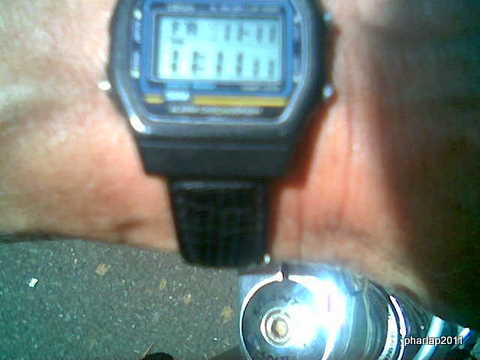
Last Friday I rode to the city on the bike. Just managed to reach the Shrine of Remembrance when 11 hours stroke. And few minutes later I watched this..


.. there is no year on my watch, so it showed only five elevens. Official ceremonies ended soon after and could see memories from those times, almost 100 years ago..


.. horse-drawn ambulance. Horses contribution to military history of Australia has been commemorated in this statue..


I still had one important point on my schedule, afternoon concert at Australian National Academy od Music (ANAM). It was only a short ride, I changed my dress and was ready. The concert started with Suite No 5 for cello by J.S. Bach. Opening Prelude was breathtaking (hear this). Next few parts went smoothly, and then, close to the end of the second Gavotte, there was some commotion behind the scene. The soloist performed few ending bars and stopped. An official appeared on the stage and announced a short break due to someone in the auditorium needing medical help. People started turning heads looking for a person in need. I did the same and saw few candidates for medical help, but was quite worried as many people looked questioningly at me. Luckily, the official asked us all to move away to make medical procedures easier. I got the message - who is not able to leave the room, will be taken by the ambulance. People hurried outside. In the foyer we could refresh ourselves with cooled water and fill declarations of donations for the Academy. The second option had also desired effect - people went outside, preferably on the other side of the road. After few minutes paramedics transported unlucky person to the ambulance and we were invited inside.
The soloist bravely performed the last part of the Suite. Then we listened to very refreshing French songs, and finally Till Eulenspiegel by Richard Strauss. Not the original piece for full orchestra, but a condensed version for an instrumental quintet. How light and witty it was! Check here.
Time to return home. I rode to the station and took the train. There was one thing, which bothered me a bit: how come, that the only photo I took from the WW I memories, was an ambulance? Was it a prediction of things to happen at the concert?