Showing posts with label history. Show all posts

Thursday, December 4, 2025

The Goddess of Warsaw

The Goddess of WarsawThe Goddess of Warsaw by Lisa Barr
My rating: 1 of 5 stars

This book upset me very much.
I appreciate author's skill and effort to write a breathtaking story of passion, sex, betrayal and murder but I cannot accept mixing this shit with the history of Warsaw Ghetto Uprising.

View all my reviews

Monday, February 3, 2025

Lech Lecha

My name is Lech.
The Poles nod in understanding - we know the beginning of the Polish state...

A long time ago, in a certain Slavic settlement, there lived three brothers, Lech, Czech and Rus. They lived under a great holy oak, from which a holy spring gushed, from which a holy horse drank. The brothers lived in harmony with each other and with nature, in everything listening to the old and wise priest, who knew everything about nature, people, life and the world. He healed, advised and interpreted dreams, both young and old. The brothers once dreamed of horses, and the priest told them that these dreams would soon come true. When they were young men, their father gave them three foals, which they were to take care of so that they would serve them. The priest of the settlement gave them another, white horse. He ordered them to set off on a journey and follow this particular horse until they reached the great northern temple.

Source HERE.

Still it is not a popular name in Poland, personally I never met another Lech. Significant point might be that there was no Catholic Saint of this name, my parents had to give me a second, "proper" name for Baptism.

In my case, the case has been going on for 2 generations. End of XIX century, my grandparents lived in Mazovia, in the Russian partition of Poland, it was a period of tightening restrictions, and there was also information about discrimination against people of Polish origin in the German partition. My grandmother as some form of protest, decided to give her children old Slavic names - Ludmiła (1892), Lech (1897), Ziemowit (1902).
I was born in 1941, under German occupation, my Mother recalled that by giving me this name my Parents gave themselves courage.

So I am Lech ... Lecha...


Lech Lecha...

80 years passed and then, 2 years ago,  I experienced a shock.

In mid-2023, I became subscriber of The Jewish Independent Media. I found it quiet interesting and balanced in its opinions.
At the end of October 2023, I read a message in the newsletter that shocked me - this week is Parashat Lech Lecha...

What is this???
Here you are...


Please click on the above photo...
So - Lech Lecha - simply means - go forth to the land that I have destined for you.

Wait a minute... and what did the priest order the legendary brothers - to set off on their journey... to the north.

It obviously reminded me of the name given to Poland by some countries:
- Iran - لهستان - Lahastan.
- Turkye used similar name for many years but then changed to Polonya.

And one more thing - the word Lech - it definitely does not sound Slavic to me - Listek, Leszek, Zlechic, Szlachcic are different, but Lech - long L and guttural CH/H - I got used to this during my two-year stay in Middle East.

On this basis, I have developed my own fantasy...
The beginning of the 7th century, the lands that once belonged to the Canaanites, Philistines, Israelites are taken over by Muslims. Mass emigration of Jews begins - to Spain, Syria, Turkey, Greece.

The Khazar tribe is formed in Turkey - CLICK - and there is a mention of  conversion to Judaism

It seems logical to me that in this situation the Khazars recited the Torah and the words they heard from God - Lech Lecha.

And the other side of the coin - these very words signalled the approach of the Khazars to the Slavs, it seems natural that they thought that the newcomers were introducing themselves by giving their name - Lech.

I wonder how I - Lech - should respond to this brotherly call.

So far I fill the waiting time with numerous Lech Lecha entertainments:

Bingo!


Song..

Play - HERE .

Crossword...


Most tasty I left to the end...


Note: this year Parshat Lech Lecha comes on 1st of November.

P.S. The YouTube channel offers dozens of videos on this topic - some very interesting - CLICK.

Monday, October 14, 2024

Gemini

 Gemini -  yesterday Google notified me they can support me even better - new Assistant - Gemini - CLICK.

I am open to interesting suggestions, so I tried.
- Who won this year's Nobel Prize in Literature?
- Han Kang, South Korea.
- How many women have won the Nobel Prize in Literature?
- 18, in recent years they have won more often than men.

That's right.
On the sidelines I will mention that the Prize has been awarded 116 times, so it will take a long time for the gender balance to even out.

Then I asked if any books by this author are available in public libraries in Melbourne.
They are, I was given the appropriate links.

Seeing that my Twins know something I tried something that really interests me...
- Do you know anything about Joice Nankivell-Loch?
- I don't know, it may be private information that I don't have access to.

Transcript of the further conversation below...


I admit that my answer was brusque, but I think it was justified.

I was interested in the matter because an Australian woman with that name was decorated with the Polish highest distinction - Order of the White Eagle in 1923. The decoration was probably made by the Chief of State - Józef Piłsudski.

I know quite a bit about this lady, I bet that more than 99.9% of Australians.

Unfortunately, I did not do better on Polish soil.
Last year, on May 3, the 100th anniversary of this decoration struck, so I sent an email with this information to:
- President of Poland - A. Duda,
- The Polish consulate in Australia, 
- The Australian consulate in Poland.

In the email I suggested that it could be a nice element during diplomatic meetings.
The Polish Consulate in Australia responded nicely.
The other two recipients - not a word.

I don't have any major complaints - Joice Nankivell-Loch definitely didn't feel good in Australia, she chose to do charity work in other countries - Poland, Greece, Romania, British Mandate of Palestine. I'm not surprised that Australians don't know about her.
As for the President of the Republic of Poland, I got a warning that the Chancellery is not able to respond to all emails, so I they don't guarantee a response.

But Artificial Intelligence?

Just be aware!

Friday, March 22, 2024

Visit at The Magic Mountain

 I was lucky with Thomas Mann because I didn't start my relationship with him from The Buddenbrooks. My mother recommended The Magic Mountain to me, I found it in the library at the student residence and it enchanted me.

When I think about the details, I see many weak points in The Magic Mountain, but it seems to me that a person in love sometimes likes to find small flaws in the object of his affections.

The protagonist of the novel comes to visit his cousin who is staying in a tuberculosis sanatorium in Davos.
He comes for 3 weeks. In the sanatorium, he discovers the charm of freedom that illness gives – a loosening of morals, a lack of sense of responsibility.
He also discovers the memory of his youthful anxiety, which here takes the form of a green-eyed Russian woman and which causes him a low-grade fever typical of this place.

What is the effect and what is the cause?
It does not matter, the important thing is that he does not want to be cured of it. He willingly accepts the offer to extend his stay to 7 weeks in order to undergo medical observation.
Before he knows it, 7 months of this morbid condition have passed.
It is not until February 29 1908, a day that is also a quirk of the calendar, that he dares to speak intimately to the object of his feelings.
The next morning, his beloved leaves. It is not known where, it is not known whether she will ever return.

Our patients always come back here in the end – states the head doctor of the sanatorium – Councillor Behrens. And Hans Castorp remains.
The stay lasts a total of 7 years. This passion of Thomas Mann for numbers extended the book beyond the limits of patience.

I waited even longer.
In 2003, six times 7 years after the start of the spell, I went on a pilgrimage to The Magic Mountain. The pretext was another ski marathon. Instead of starting from Hamburg, like Hans Castorp, I started from Okęcie Airport in Warsaw.

It was Ash Wednesday. Waiting at the airport, I watched a TV news report – on the screen, Polish cardinal sprinkled ashes on the heads of the faithful.
Three days earlier, I had heard the gospel about how Jesus explained why the apostles did not observe fasting – when they were close to me, they did not have to fast.

In 2 hours I was in Zurich. Sunny. There was a food fair at the train station. It smelled beer and sausages
"Could it be that the Swiss are closer to God?" I thought.

Instead of going straight to Davos, I was heading towards St Moritz for Engadine Ski Marathon...


Next day after the race I took the train to Davos. The route led downhill, which struck me as very funny because it destroyed all the pathos of the phrase often repeated in the book: ...up there on the mountain.
I got off, like Hans Castorp, in Davos-Dorf…

After getting off the train I looked around – "…they turned left across the track, crossed the river…"
 – that made no sense at all, because then they would have ended up on the northern slope of the mountain, where the sun doesn’t reach, and therefore there are no sanatoriums.

After checking into the youth hotel, I went straight to the Waldhotel Bellevue - Sanatorium Berghoff. A steep walk up in Buolstrasse.
"…our sanatorium, as you can see, is even higher than this town – Joachim continued. – Fifty meters higher. The brochure says one hundred, but in reality it is only fifty…"

The lady at the reception was prepared for such visits and first sold me the book Thomas Mann and Davos, and then directed me to a corridor where there were hotel memorabilia from 90 years ago; at the end a room with original furnishings:
"... a white metal bed, a sink with nickel-plated taps... an American woman died here the day before yesterday, of course everything was thoroughly disinfected.".
There was a surprise though - a chamber pot! Thomas Mann omitted this detail in his novel. He also did not mention a bathroom. Right - there was none.

At the hotel I looked through the newly acquired book and burst out laughing on the first pages.  Thomas Mann deliberately changed the topography of Davos to prevent gossip and unhealthy sensationalism around existing facilities. So my surprise at the station was explained.

Davos itself – a typical ski resort, only maybe a bit bigger and with a lot of normal residential buildings and of course the congress centre, where the World Economic Forum and many other international meetings are held, but that is not part of this story.

People? Lots of young people with skis and snowboards. Unpretentious crowd. I found a note on the internet that the nightlife in Davos is not very exciting.

And what about those… “Englishmen with white teeth, heavily perfumed ladies, Americans with small heads… a rather suspicious crowd”?
If I met them anywhere, it was not in Davos, but at the Kempinski Hotel in St Moritz.
I spent the next day downhill skiing, but I did not bother to find the trail where Hans had his strange dream.

On the last day I returned to the Berghoff, sorry to the Waldhotel Bellevue. I found the Hohe Promenade and set off for a walk in the footsteps of the characters in the book.

The path was wide enough for three people, so Hans Castorp and Mr Settembrini and Mr Naphta walked side by side, and I walked a little behind. Listening to their discussion, I didn’t notice until we reached the Schatzalp Hotel…


"The highest located sanatorium is Schatzalp, there, on the other side, you can't see it from here. They must be shipping their bodies on bobsleighs, because the roads are covered".

Another piece of evidence confirming the author's deliberate distortion of the topography. Schatzalp is on the same slope as Waldohtel Bellevue. It must be there, because only this slope faces south.

Instead of a bobsleigh track, I found Bobbahnstrasse and a toboggan run that no one has used for a long time...


On the way back I visited the cemetery but didn’t find any of the names mentioned in the book…


Two hours later I was going down, this time on the “correct route” via Lanquart to Zurich. 

Since then I have often recalled this visit.
Its dry description does not sound very interesting. But I was not disappointed.
And now? The enchantment has lasted over 9 times 7 years.
Another year has begun, so it is a perfect time to remember how:
"It was the middle of summer. An ordinary young man was driving from Hamburg, his hometown, to the spa town of Davos in the canton of Graubunden…"

Thursday, October 19, 2023

Storrada

 In the wonderful book by Antoni Gołubiew - Bolesław the Brave - Świętosława - the sister of the brave king is mentioned.

The Scandinavians changed her name to Sigrid and added the nickname Storrada, which the English Wikipedia translates as Haughty - CLICK.

The name had to be changed because for Scandinavians Świętosława was too difficult to pronounce. And there was no shortage of opportunities to speak - Sigrid became the heroine of many Scandinavian sagas.

Google translates storrada to - great line. Absolutely right - from the Piast dynasty!

In Gołubiew's book, Świętosława appears in Bolesław's camp when he is fighting the Vikings on the island of Wolin.
Świętosława, the wife of the Swedish king Erik the Victorious, had just been widowed and wanted to find out whether she could count on support of her brother.
The answer was no, Poland is involved in wars on several fronts - cope on your own, sister.

And she did as advised...

The first thing is to find a husband - a Swede.
There were several competitors, no audiovisual message, so Świętosława invited them all to her castle at the same time - show what you are worth.

The presentations must have been very poor because after a short time the queen ordered the building in which the suitors were sleeping to be set on fire at night and all of them burned down.

Here, however, Świętosława played not very fair because she was already in love with Olaf Trygvasson, the king of Norway - CLICK.

Too bad, it happened, the suitors were burned, at least no one can accuse her of not looking for a local product, now Świętosława does not have to hide her feelings.

She sent a messenger to Olaf - come, Viking - take me!

And Olaf sailed with his fleet to Gothenburg.
Here I am Storrada, but don't expect me to come ashore, you come to me.

The Vikings built a bridge and covered it with a red carpet.
Storrad walks proudly - I'm going to my beloved - look at me.

Olaf watchd with a smile, suddenly gives a signal and the Vikings, hidden under the pier, cut the spans. The bridge collapses,  Storrada falls into the water, Olaf laughs out loud - you have learned your lesson, treacherous woman!

This insult demands blood, but what can a single woman do?
Simple - propose marriage to King Sven Forkbeard of Denmark. Of course,  under condition that he hits Norway.
Deal you can not throw away.

In the year 1000, Sven, supported by the Swedish king Olaf Skotkonung (Swietosława's son), attacks Norway. The main sea battle celebrated in numerous Norwegian sagas takes place near Svold - CLICK. Olaf loses most of ships and, to avoid capture, jumps from his ship into the sea.

And they saw him that much, although there are rumours that later someone encountered him in Jerusalem

Having achieved her goal, Świętosława gave birth to two sons to her Danish husband. Harald and Canute the Great were respectively kings of Denmark and Canute was also king of England - CLICK.

After the death of her husband - Sven Forkbeard - Świętosława returned to Poland, but when two years later her son Canute the Great took the English throne for good, he invited his mother to his court.

Old times, old stories, sometimes contradictory.

I have not found anywhere confirmation of the scene of flooding Świętosława described by Gołubiew. All sources mention that Olaf hit her in the face with his glove. The reason was the refusal to accept Christianity. An illustration of the meeting with Olaf below...
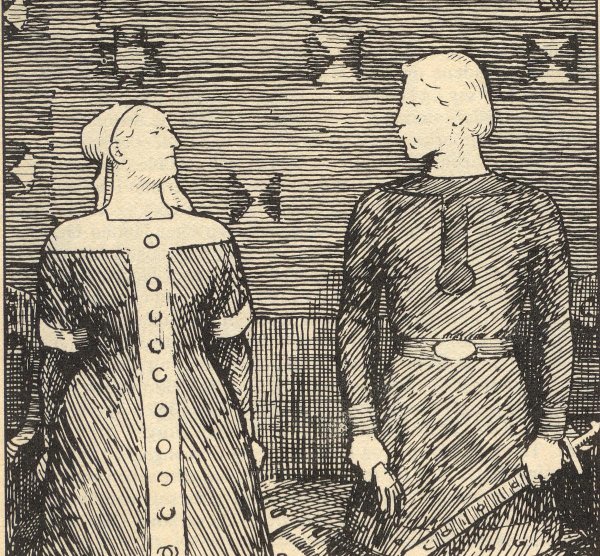
Sigrid i Olaf

Source - Wikipedia


Świętosława, daughter of Dąbrówka, queen of Poland who brought Christianity to the country,  was a pagan?

I think it's very likely.
This is indicated by the pagan name.
Both Olaf Tryggvason (interesting fact - he spent his childhood in Kiev) and Bolesław the Brave (interesting fact - he spent his youth at the imperial court in Aachen and witnessed the opening of Charlemagne's tomb) mercilessly suppressed pagan customs in their countries, but it was great politics - to be or not to be be on the European map.

And what was there in the soul? The woman did not have to publicly flaunt her beliefs.

Some sources say that Storrada burned only two suitors.

Only one source mentions Olaf being spotted in Jerusalem.

The Norwegian sagas attribute Sygrida Storrada's experiences to several women.

I'm not surprised, it's hard to fit it into one life, it's hard to fit it into a Norwegian head.
You have to be from the Piast family.

An example of this confusion can be found here - CLICK. The genealogy website states that Sigrid Storrada was the daughter of the Swedish warrior Tosti, but at the same time it informs that the alternative mother of Storrada's children could have been Sigrid MIEZKODOTTIR, i.e. Mieszko's daughter.

I am reminded of Father Józef Tischner's classification of truths:

- shit not the truth,  some truth and the holy truth.

Personally, I prefer the writer's intuition to the glass and eye of historians or the fantasies of Norwegian storytellers.

In what they say there is some truth, but only Antoni Gołubiew gives the holy truth about Świętosława.