Showing posts with label Vietnam. Show all posts

Monday, April 24, 2017

Our man in Vietnam - 6 - the heart of the darkness

My last day in Vietnam. In the morning our guide, Hoc, introduces us to Urban Adventures, a branch of Intrepid. Our new guide is Tan.

The aim of today's tour is Cu Chi, a network of underground tunnels used by Viet-Cong (Communist army) to fight Americans.
Tan knows something about this subject. His father joined the army at the age of 16 and spent 10 years in the tunnels. Tan declared himself as a communist so I tried to verify my knowledge about functioning of Communist Party in Vietnam.
- On 18th birthday everyone receives a Communist Party membership declaration, but very few fill it. This a guarantee of a career in the army or public administration. I did not join, I preferred a job of my choice - says Tan.
This is quite different from what Hoc told us, but the essence is the same. There is some ruling Party elite, which has 2 armies - the real, military one and the army of obedient bureaucrats.
- I avoided the army service as well - continues Tan - we have mandatory conscription, but I got a medical certificate. In Vietnam there is no age pension, so I have to work to support my parents.
Hoc told us identical story.

Our first stop is in the village. Idyllic, rural atmosphere. Female host is occupied with production of rice paper. Thick rice pulp boils in a cauldron. A woman pours a bowl of thick liquid on frying pan and after few seconds lifts with a stick a thin sheet of rice paper,

She lays it on a wicker stand. In a day she will produce a thousand of such sheets, which she will sell for US$40. At the same time she looks after other farm activities. Most obvious are very friendly pigs.

Tan watches us with a slightly ironic smile.
- Beautiful, isn't it?
We wholeheartedly agree.
- So why Americans came here, over 12,000 km away from their country, to destroy it all with bombs and napalm?

In silence we board the bus and depart towards Ben Duoc, a location of Cu Chi tunnels.
- Do you know, that initially, at the end of II World War, CIA supported Ho Chi Minh? - asks Tan.
We did not know. Back at home I checked. Apparently he meant support given to Ho Chi Minh in 1945 by the Office of Strategic Services, predecessor of CIA. Probably they did not mean to support communists, rather to keep French in check. Just another strategic game.

Cu Chi, a network of some 120 km of tunnels used by Communist army and sometimes sheltering the local population. Most of tunnels were dug 3 m under the ground. When Americans started regular bombing some extra tunnels were dug 6 m underground.When they introduced B52 bombers, tunnels were dug 9 m underground.
Tunnels were 1.3 m high and 40 cm wide. It practically eliminated American soldiers from penetrating the tunnels. Bombs and gases were the usual weapon.

People living in the tunnels could leave them only at night. Hot meals could be prepared only at early morning when earth was covered by thick fog. The most common food were tapioca and green tea. Tunnels inhabitants were plagued by malaria and parasites. Very often they were attacked by poisonous snakes as their nests reached the tunnels.
Serious issue was ventilation. Outlets of ventilating channels had to be well hidden. Pepper was sprinkled around to confuse American dogs.
We were listening to this story standing next to the tree. The ground covered by a thick layer of leaves.

Suddenly the leaves move and a Viet-Cong soldier appears.

Shouts of surprise, photos.
- Anybody wants to try?
Of course.

I walk down on two very uneven steps and I feel very uneasy, I do not know where to put my foot.
- Straighten up your arms or you will get stuck - shouts the guide.
I straighten them and cannot make a step. Too low, too narrow, too tight.

I crawled somehow underground, placed the lid over the hole and even did not think how I will get out. Hard not to think as after few seconds I choke with the lack of fresh air.
Fact that I write this story means that I got out somehow, but honestly, I do not know how.

So what, the guide tempts: you can walk along these tunnels, it is only 40 m distance, and for tourists the tunnels were widened to 70 cm.
Well, if they are widened I will try.
After 4 metres I regret my decision. The back aches from the deeply bent position, but the worst is a terrible lack of fresh air.

The silhouette on the photo is someone ahead of me.
- And now you can visit a birthing room, it is 6 m underground.
No, no, no!

Close to tunnels is a shooting range. Tourists can try various types of guns. Most popular is AK47, still in use. There are many people willing. Not me, I tried it in Polish (communist) army, 57 years ago.


I agree, an excellent gun.

At the end of the tour a typical tunnel meal: tapioca and green tea.

To survive on such a diet - a day, a week, months?
Apparently quite a number of people, who spent years in the tunnels, after the war could not accommodate to normal life. Too much fresh air and clean water. Their ruined organisms could not cope with it.
Detailed information about Cu Chi tunnels HERE.

Our group returns to Ho Chi Minh City, but for me it is the end of the tour. I leave the bus when it is not too far from the airport.
My farewell lunch is a wonton soup.

 Last steps in the airport and, similarly as at the beginning,,,

At the end was a book.
I noticed a small book stand. Graham Green - The Quiet American - of course. But also...


A Prison Diary - a collection of poems written by Ho Chi Minh (in Chinese).
Ho Chi Minh was arrested in China in 1942 by nationalist (Kuomintang) government and spent over a year in various prisons. One of results were poems. Here are two of them.

Scabies
Covered in red and blue as though dressed in brocate
Scratching all day long, we seem to be playing the guitar.
Honoured guests, of our rich garbs we make a parade.
Strange virtuosos, sharing an itch for music we surely are!

Evening scenery
A rose blossoms, and then fades.
It blooms and withers-listless.
But its scent the cell invades.
And arouses the prisoners' bitterness.

***

English translation by Dang The Binh.

And now everything moves quickly. Again I am on the board of Malaysian Airlines, under Allah's care. Several hours later the screen reads - Distance to Mecca: 12,718 km .
That means I am in Melbourne.


Vietnam links to all parts - Part1Part2, Part3, Part4, Part5, Part6.

Thursday, April 20, 2017

Our man in Vietnam - 5 - Mekong Delta

I was woken up by a rooster cock. Strange, during our trip so far, in every hotel I could hear rooster cock in the morning. Hotels were surrounded by city blocks. No parks nor gardens. So where these rooster lived? On balconies?
I turn to the other side and then I hear a church bell ringing. Right, it is Sunday. I get up, go to the window and I can see a church tower nearby. I run down to the reception.
- How to get to that church nearby? - I ask the receptionist.
- Church? What does it mean? - he answers
Apparently he does not know this word. No wonder. Wikipedia says that 73% of Vietnamese population do not belong to any religion. 12% are Buddhists, 8% Christians. Interesting, that in recent years number of people declaring belonging to some religion, grew. Buddhists gained most.
Wikipedia mentions also some local religions. Such as Cao Dao...
"Caodaism, the invention of Cochin civil servant, was a synthesis of the three religions. The Holy See was at Tanyin. A Pope and female cardinals. Prophecy by planchette. Saint Victor Hugo. Christ and Buddha looking down from the roof of the Cathedral on a Walt Disney fantasia of the East, dragons and snakes in technicolor."

Graham Greene - The Quiet American.

Interesting, but time is running out. Walk to the church is short. It is named Huyen Sy.

Despite early hour, 6:20 a.m. there are many people inside.

I cannot stay long, today we are taking a tour of Mekong Delta.

Mekong, river-food provider. It starts somewhere in Tibet. Winds down over 4,000 km bringing lots of minerals. This, combined with a tropical weather creates ideal agricultural conditions. At least three crops a year.

We board a boat. On our way 4 islands: Unicorn, Phoenix, Dragon and Turtle.

On Unicorn Island we visit an apiary, where we taste delicious honey. Some sweetness must have remained on me as I got a sympathy of the local mascot.

Now, on a smaller boat, we sail to Dragon Island.

This island is quite large, so we climb tuk-tuks to explore.

Again, like on the motorbike, all the excitement of travelling on a narrow path.

Our destination is a coconut factory. Here every element of a coconut is utilized. Most visible outcome is coconut candy.

Hop on a boat again. Late afternoon we return to Ho Chi Minh City and visit the central district. Notre Dame Cathedral.

The evening is coming, it is time for a farewell dinner. Intrepid invited us to KOTO restaurant.
KOTO: Know One (unemployed) Teach One (some trade) - details HERE.
Time to part with our guide - Hoc. He won respect and sympathy of all of us. The senior of the group, Jac , delivers a quite touching farewell speech.


Time to have a last look at our complete group.

Vietnam links to all parts - Part1Part2, Part3, Part4, Part5, Part6.

Thursday, April 13, 2017

Our man in Vietnam - 4 - the War

Day starts early as at 7 am we fly out from Da Nang to Hi Chi Minh City (formerly Saigon).
It is worthwhile to mention, that Vietnam is an over 3,000 km long strip of land of average width about 100 km. It makes area slightly smaller than Poland and some 40% larger that our Australian State of Victoria. But population - around 90 millions, 15 times larger than in Victoria.
Out hotel day not started yet so we begin from visiting War Remnants Museum - CLICK.

Before entering the Museum our guide thanks us for understanding as Australia was involved in this war, on the other side.
I am also asking my readers for patience and tolerance as my relation is strongly influenced by impressions from the Museum, which has been built and maintained by the current, communist government of Vietnam.

War Remnants Museum, to be precise two wars as first was the French war , years 1945-54.

Year 1945 - Japan capitulated, French Vichy government capitulated too. In this vacuum enters Ho Chi Minh with his idea on independent, communist Vietnam.
At the same time, at the Potsdam Conference, it has been agreed, that the South part of Vietnam will be included into British Southeast Asia Command and Japanese forces in the North will surrender to Chinese, Kuomitang forces under command of Chiang Kai-shek.
Chinese accepted Hi Chi Minh activity. British in the South waited for decision of France. Interesting, that at this time American Office of Strategy Services (Predecessor of CIA) supported Ho Chi Minh claim to South Vietnam.
On 23 September 1945 France declared its rule over South Vietnam and the guerrilla war started.

Year 1949 - China became a communist country under Mao Tse-tung. North Korea was under Soviet administration. Vietnam became a part of communist block.
1953 - USA decided to support France.
Justification: “Now let us assume that we lose Indochina. If Indochina goes, several things happen right away. The Malay Peninsula, that last little bit of land hanging on down there, would be scarcely defensible. The tin and tungsten that we so greatly value from that area would cease coming.”  - president Eisenhower - CLICK.
American support amounted to 400 million dollars.
Year 1954 - communist forces under general Giap defeated the French army. At the peace conference in Geneva France declared full withdrawal from Vietnam.
Full history of the First Indochina War here - CLICK.

American war in Vietnam practically started in 1953, with military support mentioned above. After French withdrawal South Vietnam was ruled by non-communist nationalists under prime minister Ngo Dinh Diem. He was a staunch anti-communist and a fanatical Catholic.
The first gave him full American support, the second resulted in persecution of other religions, mostly Buddhist. It was a cause of numerous protests and culminated in self immolation of a Buddhist monk Thich Quand Duc.
Ngo Dinh Diem treated ruthlessly all political opponents and became a quite unpopular figure. His popularity waned and eventually CIA sent a supportive message to South Vietnamese generals planning a coup d'etat.
Ngo Dinh Diem and his brother were murdered on 2 November 1963.

Organizers of the coup d'etat were invited to American Embassy to celebrate. US president J.F. Kennedy sent a cable to congratulate "a fine job".
Ironically, 20 days later J.F. Kennedy was dead.

After fall of Ngo Dinh Diem political situation in South Vietnam became very unstable. There was a long succession of military governments. As a consequence American troops landed in Vietnam.
Hi Chi Minh warned Americans: "If they want to make war for twenty years then we shall make war for twenty years. If they want to make peace, we shall make peace and invite them to afternoon tea".
Military operations did not bring success as the nature favoured Vietnamese (communist) partisans. So the war against nature started. Spraying forests with chemicals causing defoliation (loss of leaves). One of companies involved in this project was Monsanto, the same which tries now to dominate the world with genetically modified plants.
More radical weapon was Agent Orange - CLICK - which caused grievous health consequences for those who came in contact. Up to 4 million people in Vietnam were affected and 1 million people have illnesses. The chemical has damaged the genes, giving descendants with deformities. American war veterans, who had contact with Agent Orange were awarded compensation.
Vietnamese people will suffer consequences for a long time - read this - CLICK.
Full history of the Vietnam War here - CLICK.

In he first section of this story I mentioned influence of Graham Greene's book - The Quiet American on my choice of Vietnam. Another significant influence was a movie Apocalypse Now based on a book The heart of the darkness by Joseph Conrad. Here is a trailer from the movie - CLICK.
Watching this trailer I have memory of one more writer - John Steinbeck who visited Vietnam as a war correspondent.
"The author was impressed with American war technology, especially the helicopters and the gunship they called “Puff the Magic Dragon,” which could saturate a football field in a few seconds with .50-caliber bullets. It never occurred to him that, in an insurgency, such a wide swath of death in heavily populated areas would not enhance the winning of “hearts and minds.” He asked incredulously: “How could we lose a war against peasant rabble when we had all the modern advantages?”- CLICK.

Here is the effect of modern advantages.


Memories of worldwide protests against the war in Vietnam are well exposed in the Museum.
Above a Russian poster - hands off Vietnam!
There are photos and reports about protests in USA, France,Soviet Union, Hungary.

Close to the exit from the Museum I noticed a book stall...

Second from the left in the bottom row The Quiet American and above, slightly to the right, the French response - The little Prince by Antoine de Saint-Exupery.
Looks a bit sarcastic as next to the Museum, just behind this wall...

there is an old French prison. These bars in the floor this are ceilings of prison cells. Sometimes there were dozens of people packed into each of them.


Graham Greene got it easy. Just in this conflict Britain stayed neutral. And Antoine de Saint-Exupery? He also avoided a trap - did not return from a reconnaissance flight in 1944.

End of the tour. It is good to be again amongst alive.


In Melbourne, reading the tour description I noticed with some sadness a mention, that in Ho Chi Minh City there is an option to watch an AO Show.
AO Show? The obvious translation was Adult Only Show. Of course. Neighbouring Thailand is famous as a sex tourism destination. Vietnam could not avoid some influence. And everything is cheaper here.
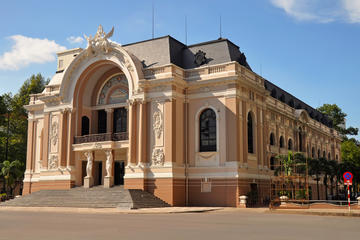
So it was a big surprise when our guide led us to stylish building of the Opera House...


... and told us, that here we can but tickets for a ballet performance - details here - CLICK.
I was very glad - our tour organizer (Intrepid) maintained a good standard from the beginning to the end. I was a bit ashamed with my association, and also disappointed a bit. Had I known what it is about I would have extended my stay in Vietnam by one day.

We end the day with a walk in Ho Chi Minh central district. Skyscrapers, elegant hotels and office blocks. Our dinner is in a top class restaurant - Lemon Grass - CLICK.

Still it is good to walk back to the hotel in a typical Vietnamese street.

Vietnam links to all parts - Part1Part2, Part3, Part4, Part5, Part6.

Thursday, April 6, 2017

Our man in Vietnam - 3 - Hoi An

Moving on, this time by bus. It climbs laboriously to the Hai Van Pass.

We came from the right, cloudy North. On the left, down, we could see golden beach and blue sea. So go down, We pass Da Nang, most industrialized city in Vietnam. It looks like in this place building projects are well run with Japanese (or Korean) efficiency.
Our guide winks - mafia - apparently Communist Party found, that dealing with foreign companies is more profitable that local industry.
Soon we are driven along the beach, clean, fine sand. You see that little white dot right from the highest mountain? The Female Buddha - CLICK
Vietnamese Copacabana.


Our aim if Hoi An - CLICK - most tourist friendly place in Vietnam. We can see it in the streets - clean, nicely decorated, friendly, relaxed crowd.


There are many old, well preserved buildings still involved in traditional craft. For example silk production.


On the upper floor we can see / buy beautiful silk tablecloth.
Popular are tailors, shoemakers, who can make overnight elegant suits or shoes.

Next day we have leisure time. What could be better than a bike ride?

We travel on flat tracks among rice fields, lakes, canals.


On our way we encounter some alternative transport means


It looks like a buffalo likes its load, it licks its lips. From passenger position it is not so easy. The animal has large chunks of fat on his back and it slides together with the rider with each step of the beasts.

Soon another attraction - basket boats.

Not far from us someone demonstrates sort of dances on the water - CLICK
Our trip is smooth, peaceful and dignified. I am rowing the boat and my effort is rewarded with spectacles.


After boat ride we continue on bikes to a very spectacular  Long Tuyen Pagoda.


Back in Hoi An there is not much time to spare as we have a cooking class on the schedule.

It starts with a visit to the market, to see what sort of vegetables we are going to use.

I am not a very diligent student, my attention is distracted by other stands.
- What are these dark lumps, next to jars?
- Blood - answers the chef - we do not waste anything.
Oooops, I hope our menu will be vegetarian.


The class is not difficult. We prepare 4 dishes:
- a mackerel grilled in a banana leaf,
- vegetarian spring rolls,
- green papaya salad with chicken slices,
- rice pancake.
Here I am in action - spring rolls.


Finally we eat what we cooked. Is OK, but I do not feel qualified for Vietnamese cooking.
Vietnam - links to all parts - Part1Part2, Part3, Part4, Part5, Part6.

Thursday, March 30, 2017

Our man in Vietnam - 2 - Hue

The night train brought us to Hue, old, imperial capital of Vietnam - CLICK.

Main attraction is the Citadel - complex of imperial palaces and temples - Forbidden City.
Good opportunity for a group photo.


Our guide - Hoc - introduced us to some basic facts from history of Vietnam. Favorable location - strip of fertile land separated from neighbours by mountains and jungle - enable creation of independent country already 3,000 years B.C. From year 111 B.C., for over 1,000 years Vietnam was dominated by China.
In 1292 Marco Polo visited Vietnam, some 300 years later it was visited by Portuguese missionaries, who introduced Latin alphabet.
The last imperial dynasty - Nguyen - came to power in 1802. In 1858 France attacked Vietnam and in 1887 it became a French colony under a name French Indochina.
Nguyen dynasty kept its imperial position, but they were just French marionettes. Situation changed in 1940 when Vietnam was attacked by Japan. Now the French administration formally  subordinated to Vichy France - CLICK - was a Japanese marionette.

Year 1945 - Japan defeated, Vichy France government falls. Ho Chi Minh arrives in Vietnam. Educated in France and Soviet Union, with good connections in China.
Let's listen to Hoc: In the last year under Japanese occupation 3 million Vietnamese starved to death. Ho Chi Minh declared - in independent Vietnam nobody will die of hunger. He kept his promise.

Ho Chi Minh was born as Nguyes Sinh Cung. Changed his name few times. Chi means will of spirit, Minh means bright, and Ho. Well Ho Chi Minh is a single exception among all Vietnamese names. Normally the last (third) segment of the name is the "first name" by which people are addressed. To address someone by the first segment of the name is a serious indelicacy, with the one exception - Ho, or as Vietnamese use to say - Uncle Ho.

It reminds me old times in Poland, end of 1960-ies. I used to visit a Club of Interational Press to read The New York Herald Tribune, international edition. Specially I liked Art Buchwald's - CLICK - column, always witty and mischievous.
One day he mentioned Uncle Ho. Here is the difference - he wrote - Vietnamese call their leader Uncle with his name as a suffix. Americans call their leaded son with some suffix.

Forbidden City consisted of 148 buildings. After French and American wars only 20 survived. None of them makes impression on me. Vietnamese flag adds some life to Forbidden City.


The next day is exciting, we will be passengers on motorbikes. I have to admit, I had strong reservations about it, which were shared by few people in our group, but eventually Hoc gently persuaded everybody to jump on the seat.


Our drivers have been carefully selected by Intrepid, it is a stable, well paid job, so they care about passengers comfort and safety. From the passenger seat we can appreciate their skills and intelligence and cooperation of all users of the road.

We ride mostly on side roads, among rice fields and small villages. We stop frequently. Sometimes it is just ducks kinder garden.

Parents watch from the other shore.

Building a dyke in a traditional way.


Manufacture of typical Vietnamese hats or incense sticks.


People are friendly, encourage us to try our own hand, usually with a pitiful outcome. Our guide suggests not to crowd around just one seller, spread around, give more people a chance to earn some money.

Important point of our excursion is a visit to a tomb of emperor Tu Duc - CLICK.
Our guide continues a brief lesson of history of Vietnam.

Emperor Tu Duc personally supervised construction of his tomb. The project started when he was still in the prime of his life. Reason was simple, he had no successor. Over 100 wives and concubines and no son.
Construction of the tomb lasted 9 years and caused an uprising of people forced to pay extra taxes and to provide free labour at the tomb.The uprising was suppressed and Tu Duc lived many years in his tomb spending time on poetry and hunting.
And guess what? Tu Duc has not been buried in his tomb. He has been buried in a secret location. All people employed at the burial have been beheaded and the locations stays secret till now.

Hoc mentioned the end of the empire. Ho Chi Minh induced the last emperor to abdicate and offered him some honorary position at the side of the government. The emperor chose to migrate to France.
It brings us to current times, communist government. Hoc does not hide his aversion to communism. An uncle of his mother was executed by communists only because he was a prosperous farmer.
Communist Party? It is mafia. Do you think anybody can join the Party? No way. There are only some 20,000 members. It is an exclusive club only for relatives of the original members.
It is not correct - Wikipedia says, that Communist Party of Vietnam has some 4.4 million members. I suppose Hoc meant those, who really count.
After the tour, at home, I do further research. Interesting, the economic policy of the Party is named Doi Moi - CLICK. What a coincidence - in Polish "doi" means to milk and "moi" means my (plural). So now we know who milks you my good Vietnamese people.
Wikipedia lists Vietnam among countries with the highest corruption in the world.

It is time to corrupt slightly our drivers. For a while we take over the handlebars of the motobikes.

The next visit - Thien Mu Pagoda - CLICK - beautiful complex on the bank of Perfume River.

Hoc - who declared himself as Buddhist - explained the difference between a temple and pagoda. In Buddhism there is no god, so it is not a religion, thus we do not have temples, but pagodas.
Still in many sources I find mentions of Buddhist temples. Interestingly, when I looked at the Internet, I noticed that most people, who ask question about difference between temple and pagoda, are those who visited Vietnam.

One of noticeable exhibits in Thien Mu Pagoda is a car of Thich Quang Duc, a Buddhist monk who self-immolated himself in year 1963 in protest against persecution of Buddhists.
Persecution of religious by the Communist Government?
No, persecution by right-wing government of South Vietnam.

Complicated is the history of this country.

We leave motorbikes and board a boat, which brings us back to Hue.


PS. I would like to acknowledge a following comment:
" I took the photo (from the forbidden city) without the flag, that’s the heritage. There were more than 3,000 victims of a massacre at Hue in 1968 by the VC (Viet-Cong - communists)."
Thank you Peter for bringing a wider perspective to my relation.
Vietnam links to all parts - Part1Part2, Part3, Part4, Part5, Part6.